> blog // 19 October 2026
What goes into a blog post people use
The parts we build a post from, each shown in one of our own: the answer first, sources quoted, a chart drawn to real data, a tool for your own numbers, and motion only where it explains.
A post earns its place when it answers a question your customers already ask, and gives them something they can check and use. Here are the parts we build one from, each shown in one of two posts: our own Google AI Overviews and clicks: what the studies say, and a sample post we wrote as we would for an accounting client, on when super is due under Payday Super.
Try it: when is your super due?
The question, answered first
People arrive with a question, so the answer goes at the top, before any background. The Payday Super sample opens with the rule itself:
Super must be received by your employee's super fund within 7 business days after payday, counting payday as day 0. This applies to wages paid from 1 July 2026.
The cases that change the date, the worked examples and the history come after it, for the readers who want them.
Every fact checked on the primary page
We read the source itself, never a summary of it, and quote it with a link so a reader can check us. Every rule in the Payday Super sample is in the ATO’s own words, linked to the ATO page it came from, and we checked each quote against its page on 19 October 2026.
"This timeframe does not change if there is an error or delay processing the contribution"
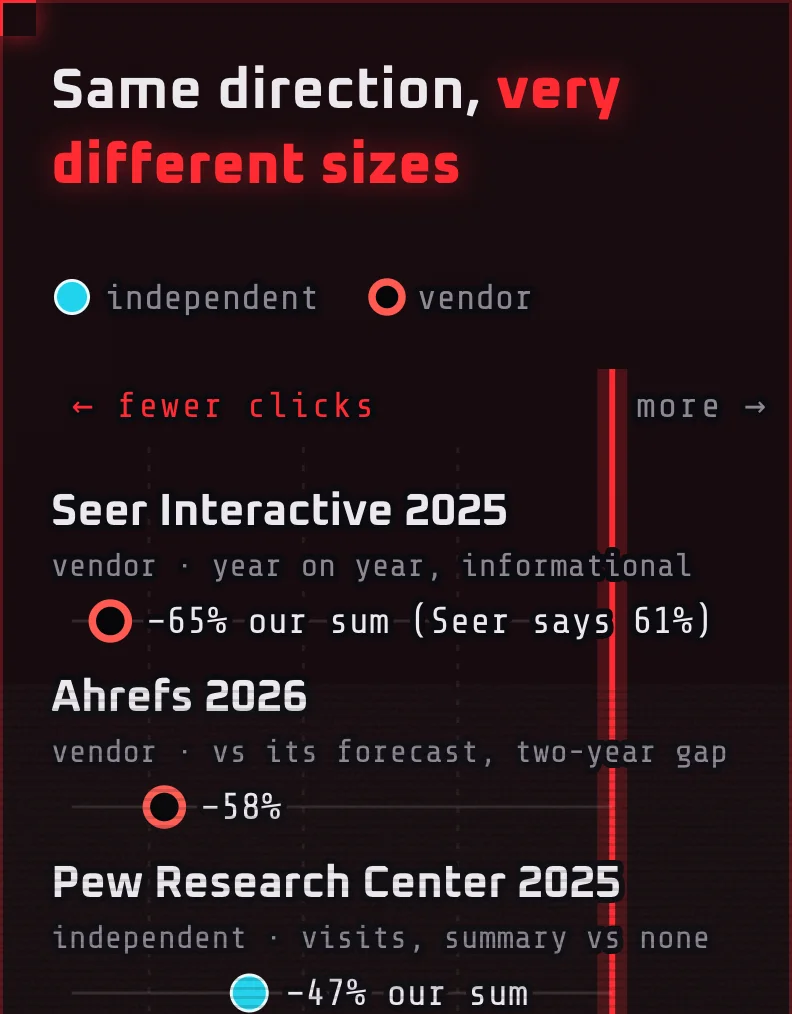
When a source and our arithmetic disagree, the post says so. Seer Interactive’s page calls one fall 61%. From its own figures, 1.76% to 0.61%, we get 65%, so the AI summaries post shows the raw figures and both readings. A second randomised experiment sits on a site that blocked us, so the post names it and says we haven’t used its figures.
A figure drawn to real data
The AI summaries post compares seven studies (nine rows, counting the Ahrefs and Seer updates separately) of what Google’s AI summaries do to clicks. Its table carries each study’s sample, date, measure, and whether a vendor ran it. Its chart then puts every result on one scale, fewer clicks to the left of zero, so the spread is the point: same direction, very different sizes.
Two results don’t fit that scale, and the chart doesn’t force them. One found slightly more clicks, measured as fewer searches ending with no click, so it appears as a direction only. The one randomised experiment we could read reported 18.8 percentage points, not per cent, so it sits apart with its own label.
A tool for the reader’s own numbers
A worked example shows a rule once. A calculator shows it for the reader’s own payday. Try the one from the Payday Super sample: set payday to 30 July 2026 and it skips the weekend and Picnic Day in the Northern Territory, as the ATO’s own example does, and lands on Tuesday 11 August 2026.
Loading the calculator.
The calculator didn't load here. It works in a sample post we wrote as we would for an accounting client.
It keeps its sources dated, so when a holiday list or a rule changes, we know what to re-check.
Motion only where it explains
Seven business days is easy to say and easy to miscount. We made a short motion study of the rule: payday is day 0, each weekend folds out of the count, and the money must reach the fund by day 7. The fold is the rule, so the movement carries the information.